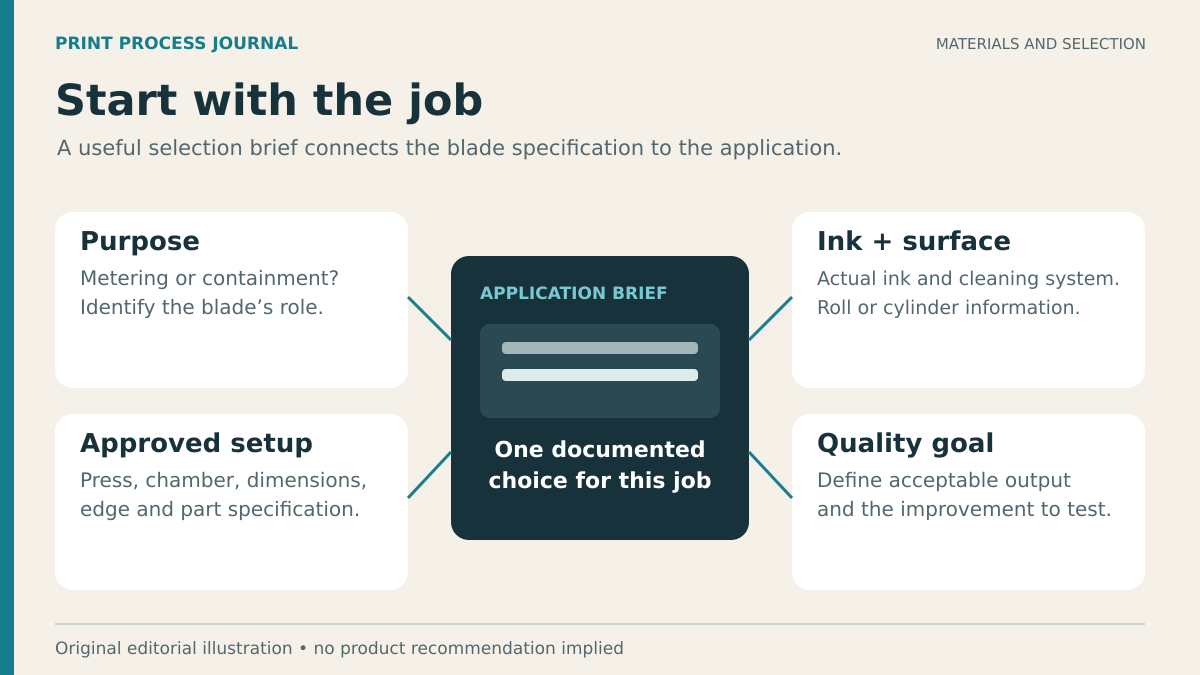
A useful doctor-blade selection conversation starts with a description of the job. Before comparing prices or asking which material lasts longest, establish what the blade must do, what it will contact, and what result the production team needs. Those details give a supplier something meaningful to work with.
This guide organizes that conversation into a practical brief. It does not nominate a universal winning material or substitute for a press manufacturer’s specification. The aim is to make a proposed change easier to understand, evaluate, and document.
Define the improvement before choosing the product
“Better performance” is too broad to test. Write down the specific problem or goal. Perhaps the team wants fewer unplanned interruptions during a recurring job, more consistent appearance over a run, or a clearer replacement schedule. Identify which outcome matters most and which existing qualities must be preserved.
Then define an acceptance condition with the production and quality teams. A longer run is useful only if the printed output remains acceptable and the equipment is being operated correctly. Agree in advance on who can approve the trial, who will assess the samples, and what would require stopping it. These are planning decisions to settle before a consumable reaches the press.
Identify the blade’s function and approved dimensions
Record whether the part is a metering blade or a containment blade, along with the press and chamber identifiers. Product families can be designed for different duties: for example, Allison’s plastic and composite range distinguishes containment products from products intended for particular metering applications.
Use the approved specification to establish dimensions, edge profile, and installation requirements. Give the supplier the actual part information rather than relying on a description such as “the blue one.” Colors and trade names are not a shared technical language across all manufacturers. If the documentation is incomplete, resolve that uncertainty with the equipment supplier before authorizing a substitution.
Describe the ink and the surface together
The ink family, its abrasiveness and chemical compatibility, the roll or cylinder surface, and the required print result belong in the same brief. Allison’s application overview distinguishes economical carbon-steel applications from higher-wear situations involving abrasive inks, and explains that coatings can change blade performance.
A useful question is: “Which feature of this job makes you recommend this blade?” The answer should connect the proposed material to the application. Ask which assumptions the recommendation relies on, especially when a job has recently changed. A supplier cannot evaluate an ink or operating condition that has been omitted from the description.
Water-based ink, by itself, is not a complete material specification. Allison’s FAQ notes that stainless steel is not required for every water-based application; the chemistry and operating circumstances matter. Confirm compatibility for the actual ink and cleaning system instead of turning a broad label into a blanket rule.
Understand what the material categories tell you
Steel blades include carbon steels, stainless steels, and tool-steel options, with coatings available for some products. Allison’s metal-blade descriptions illustrate how metallurgy, wear resistance, corrosion resistance, and coatings can differ within one broad category. “Steel” is a starting description, not the full specification.
Plastic and composite options are also diverse. Allison’s plastic and composite guide lists materials intended for different metering or containment conditions. It also cautions that a soft material can embed particles and potentially damage a roll. Avoid assuming that a softer blade automatically removes every wear or damage concern.
The practical takeaway is to ask for a recommendation at product-and-application level. A material family helps narrow the discussion, but it does not settle compatibility, dimensions, expected performance, or the suitability of a particular edge. Keep those details together in the approved trial specification.
Consider the edge and the assembly
Material is only one variable. The working tip and edge profile also influence metering, as Bill Warner explains in Allison’s technical article on blade selection and contact. That is a reason to involve the blade supplier and equipment documentation when selecting a combination.
A purchasing brief should distinguish the proposed blade change from any other work the machine needs. If a worn holder or an unresolved chamber issue is also being addressed, record it separately. Otherwise, a successful result may be credited entirely to a new blade even though several things changed together. That makes the next purchasing decision harder to defend.
Plan a comparison that produces a useful answer
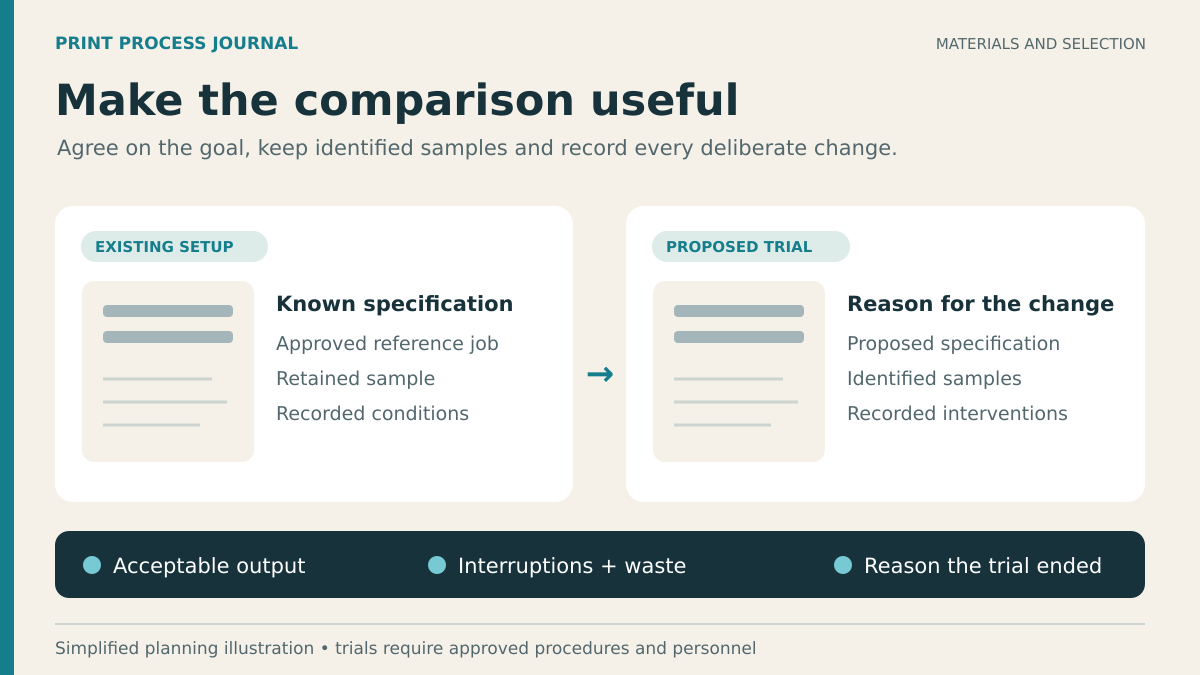
Use a familiar, approved job as the comparison point where practical. Record the existing setup, the proposed specification, and the reason for testing it. Aim to change one deliberate variable at a time. Where production realities require several changes, list all of them and avoid claiming that the result isolates the blade’s effect.
- Record the trial’s start and finish, and why it ended.
- Keep identified print samples using the site’s normal quality procedure.
- Note interruptions, rejected output, and any approved interventions.
- Compare the result with the acceptance condition agreed beforehand.
- Document remaining uncertainty before expanding use.
Consider the purchase in the context of acceptable output and production time. A low unit price and a long advertised life answer different questions. Neither replaces an application-specific comparison. Avoid importing a supplier’s promotional lifespan claim directly into a budget without checking its stated conditions and obtaining evidence relevant to the job.
Keep the selection process safe
Trial planning does not authorize an untrained person to fit blades or adjust equipment. Follow the OEM instructions, the site’s energy-control procedures, and the required handling precautions. Allison’s installation and safety discussion notes that plastic blades can also have sharp edges. Material choice never removes the need for approved handling practices.
The most useful outcome is a documented choice: this specification, for this application, evaluated against this requirement. It gives purchasing, production, and the supplier a shared explanation of why the blade was selected, and a clear starting point when the job changes.
Watch: a manufacturer’s blade-selection perspective
In this Flexo Concepts case study, Mark Andy discusses polymer doctor blades across white-ink, coating, and process-print applications. Performance and service-life statements are the speakers’ claims, not independent comparative findings or a recommendation for every press.
Watch on YouTube: Mark Andy’s polymer doctor-blade perspective
Leave a Reply